Videolog: Butterfly Wings

Friday 3 July 2009 4:25 pm | Videolog


Machines of Loving Grace
Butterfly Wings, 1993

This is one of those early 1990s alt-rock standards I’d sort of forgotten about until I landed on the 1993 Live 105 charts at this site.

Digital Collections and Endorphins

Friday 3 July 2009 9:47 am | Geeky, Work

Interesting post, if you’re interested in this sort of thing.

This Just In

Friday 3 July 2009 9:34 am | Current Events, Pop Culture, Stupidity

In case you haven’t had access to any of the 24-hour news channels, be advised that Michael Jackson remains in dead but stable condition. They’ll keep standing by, though, in case there’s any change.

“Urban” and “Dense” Are Not Always Synonymous

Friday 3 July 2009 1:53 am | North Carolina, Pittsburgh, San Francisco, Urban

I suppose you could say that my main hobby is studying how the built environment of urban areas has developed and changed over the past century. I’m more aware than most of the terrible things that have been done to the urban form in order to accommodate automobiles. Between urban freeway construction, “urban renewal,”  and the resulting demolition of blocks and blocks of otherwise viable buildings just to create surface parking lots and widen streets, most American urban centers have areas of blight, decay, and sheer blandness that resemble London after the Blitz. Overemphasis on the automobile and its needs has been disastrous for most American cities. I challenge anyone to look at before and after photos of Pittsburgh’s East Liberty district, for example, and to determine that any aspect of the “after” looks like an improvement over the “before.”

And yet, these things did happen. These pockmarked areas, “missing teeth”,  and sometimes bizarre street layouts are now part of the urban fabric. They’re part of the history of cities, just like the new façades that were given to Victorian buildings in the 1940s and 1950s as well as the generally useless pedestrian plazas of the 1960s and 1970s. Like them or not they’re texture, which to me is the very definition of “urban.” And I have to admit that I often find them almost as fascinating as disturbing. It’s my inner archaeologist, I guess, but I like trying to piece together how these areas were before they were rebuilt, and how they came to have their current configuration — even if I don’t find the actual current configuration to be particularly appealing.

And sometimes, I actually do find the automobile-based accommodations appealing. One of the things I most like about Chicago, for example, is the way you can be driving through a relatively dense urban neighborhood and all of a sudden find a 1960s supermarket or a 1970s fast food joint (or even an entire shopping center) with a small parking lot in mid-block. I understand that it horrifies many traditional urbanists and sends preservationists into wheezing fits when the streetscape is “broken,” but I often find sites like these to be  little unexpected surprises that break up the monotony and demonstrate (a) how cities adapt and change over time, and (b) that the neighborhood remained vital enough to merit that sort of investment even as urban areas were supposedly “dying.”

So where is this going and how does it relate to the title above? There is considerable pressure now in many cities to obliterate anything that isn’t sufficiently “dense,” apparently based on some arbitrary definition of how dense something must be in order to officially be “urban.” I don’t have a problem with making cities more dense and less car-dependent; I’m generally in favor of it, although I think it’s a battle that will never be won in some places. I do, however, have a problem with the idea that every block of every neighborhood within a city must have pretty much the exact same (high) level of density as every other one. And I very much have a problem with the idea of accomplishing this through wholesale clearance of the existing environment (”all at once and right now, dammit”) particularly when that environment may already be quite viable and even quite urban in its own way.

That’s the point I’m making with the title; the fact that a development has very high density does not make it particularly interesting nor urban in character. And sometimes, low-rise commercial (and even relatively low-density) commercial areas are among the most interesting places in a city. I’ll take San Francisco’s  Richmond or Sunset districts over Mission Bay or South Beach or the Financial District any day of the week.

Take, for example, Richmond’s Cary Town.  It’s a classic streetcar suburb, with mostly one- and two-story storefronts on the main street and houses — some of them rowhouses and some detached — on the side streets. Many blocks have only on-street parking, but there are some lots. One of the earliest shopping centers in the county is right in the middle of it all, and some newer ones are at the western edge. All in all, it’s a lively and exiting place.

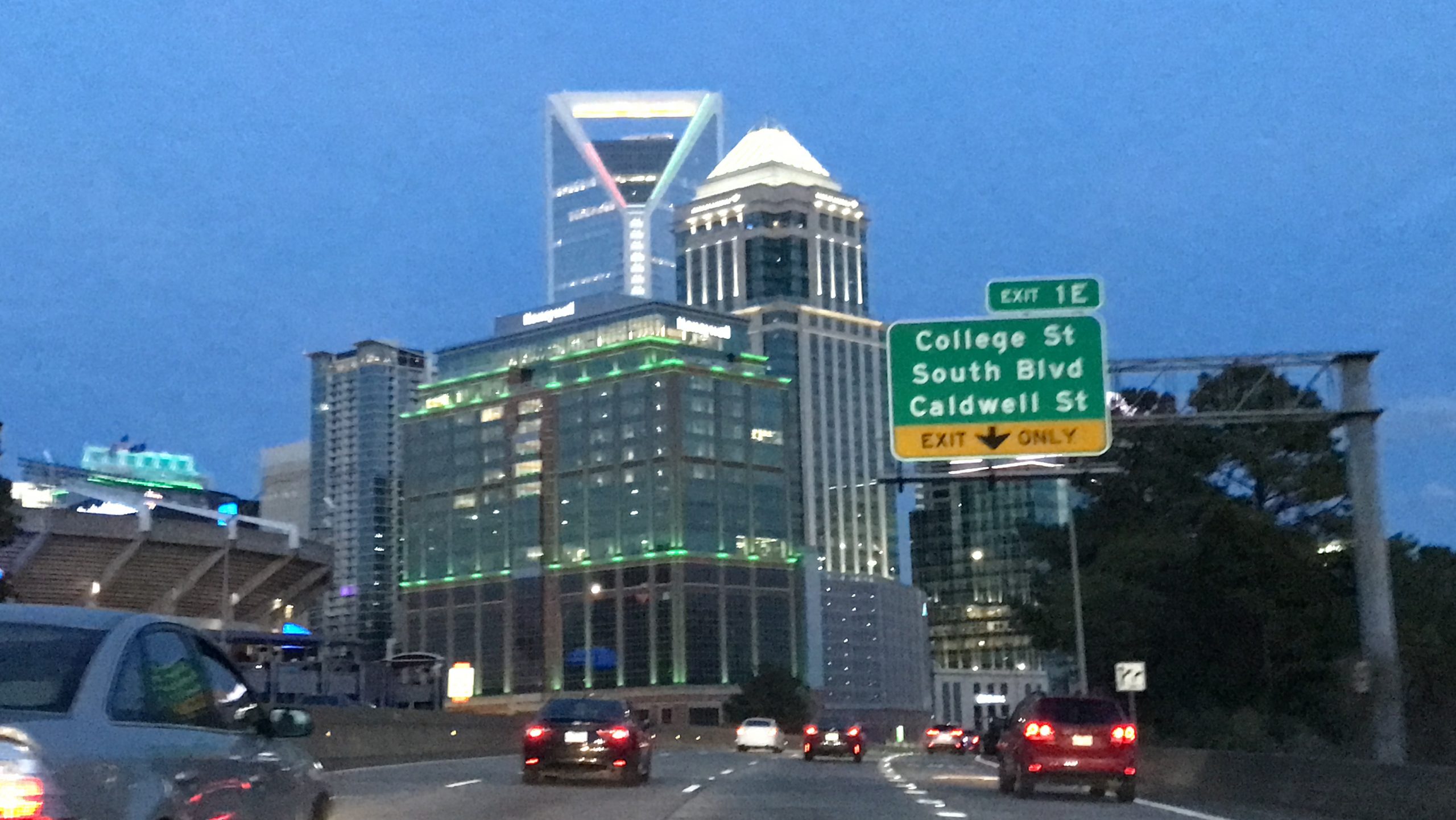
What would they have if they “impoved” it by bulldozing all that low-density development dating from the first half of the twentieth century and replaced it with a wall of high-density housing (with, of course, discreetly hidden parking garages and mandatory street-level retail)? For a start, they would most likely lose all the small, independent merchants, who would no longer be able to afford the rent. They would most likely lose most of the pedestrian appeal as well. In the end, what they’d have would be the South Boulevard corridor in Charlotte’s Dilworth, a former streetcar strip which now rivals any suburb for sheer blandness and soullessness. By god, it’s dense, though. Interestingly, in Charlotte, the auto-centered strips from the 1950s are some of the most urban areas in town, probably because most of the streetcar strips are either gone or are in the process of being “densified.”

Obviously big developments surrounded by vast seas of parking are generally not appropriate in urban areas and should be discouraged. Some of the existing ones should probably be replaced. But trying to fill every urban block with the maximum density possible (and particularly doing so all at once with massive projects) is not the way to go either. In fact, a lot of the “densification” trend, with its huge urban building projects looks just about as misguided as the car-oriented development it purports to “correct.” Wholesale clearance of urban environments is generally never a good idea, no matter how hard to love some of those environments may be. And eliminating all traces earlier development, misguided as some of it may have been, robs us of some important evidence of our urban history.

Randomly Wednesday

Wednesday 1 July 2009 12:01 pm | Geeky, San Francisco, School, Urban

Random stuff for my first weekday at home in quite a while:

Got to read five chapters before class tonight. Tomorrow’s excitement: PHP maintenance on many sites.

Could my life get any more exciting?

It’s a Boy and…

Tuesday 30 June 2009 6:36 am | Mark

Happy birthday to the most wonderful one in the world.

Next year we’ll spend it together happy and in the same place, wherever that place may be.

Videolog: I Got You

Monday 29 June 2009 11:47 pm | Videolog


Split Enz
I Got You, 1980

Anniversaries and Birthdays

Thursday 25 June 2009 12:23 am | Friends, Mark

Happy other birthday, my love. It’s been rather nice not getting drunk with you these past five years.

And speaking of anniversaries

Alternatively

Wednesday 24 June 2009 10:27 pm | Pittsburgh, Pop Culture, Stupidity

The new Pittsburgh Magazine has a blurb about an upcoming Kid Rock show where he’s described as an “Alternative/Southern rocker”. Ahem. I’ll ignore the fact that he’s actually from Michigan, but using the term “alternative” to describe Kid Rock is a little like calling Wal-Mart an exclusive boutique. Kid Rock is about as mainstream (not to mention talentless, irritating, boring…) as it gets.

But I guess that’s pretty much true of just about everything that labels itself “alternative” nowadays. I’m a middle-aged guy who doesn’t really even follow new music all that closely anymore. If someone like me has heard of every act in Billboard’s “Top Ten Alternative” chart, there is absolutely nothing alternative about it. Yes, I understand that there are actual alternatives to “alternative” but I’m talking about the genre which is now little more than a marketing term and pretty much consists of three types of music:

  1. Over-aggressive metal-inspired schlock that is more or less the same crap Korn was doing badly more than a decade ago,
  2. White trash rap-funk-metal that pales in comparison to what the Red Hot Chili Peppers were doing two decades ago, and,
  3. Bland rehashes of the Foo Fighters (and I include the actual Foo Fighters in this group as well, since they now sound pretty much like a bland rehash of themselves).

Anyway, as long as I’m ranting on pop culture, here are three more thoughts:

  • If your radio station plays a jingle that goes “cool songs in the morning on K-104.7″ and then follows it with, say, “Faith” by George Michael, people are bound to ask “What’s wrong with this picture?”
  • There is no such thing as a “gas saving SUV” and no radio commercial will ever convince me otherwise.
  • Unless they go on a shooting spree, Jon and Kate will never be newsworthy*. Neither will Perez Hilton. And that’s good.

*Yes, I’m admitting here that about two weeks ago, until we both read Leonard Pitts’ column on the subject**, neither the hubby nor I had a clue who the fuck Jon and Kate were as they glared at us from tabloids in the supermarket.

**I’m also admitting here that Leonard Pitts is kind of my favorite newspaper columnist these days. But that’s off-topic.

Zombie Time

Monday 22 June 2009 10:56 am | Personal

The great thing about (unintentionally) waking up three hours earlier than you really need to is that by 10:30, you feel like you’ve really gotten a lot done. The bad thing is that by 11:00, you’re so tired you don’t care.

Next Page »